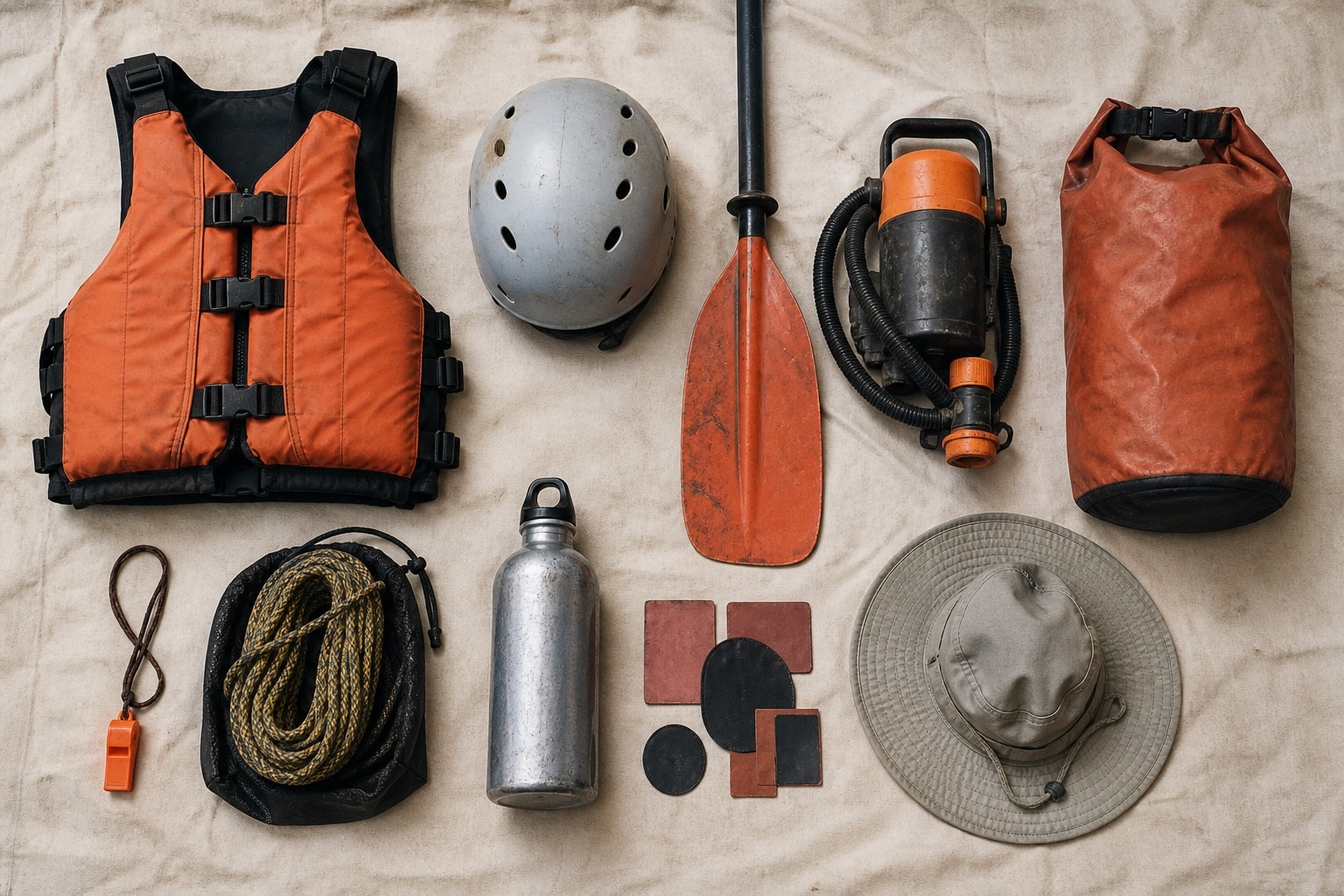
Pack Systems, Not Just Objects
A gear list becomes more useful when every item belongs to a function. That makes omissions easier to spot and helps a group understand why something is carried. The exact equipment depends on the craft, route, season, rules, and training. This checklist is an organizing method, not a substitute for current requirements or qualified instruction.
Worn protection
Begin with a properly fitted life jacket appropriate to the activity, secured footwear, clothing chosen for water exposure, and a helmet where the water and activity call for one. Sunscreen, a brim, and eye protection address the canyon sun, but nothing worn should interfere with the life jacket or create an entanglement hazard. Review the current public life-jacket guidance for fit and use labels.
Boat control
Paddles or oars should match the craft and crew. Check handles, blades, shafts, locks, frame connections, seats, foot cups, perimeter lines, valves, and inflation pressure. Carry an appropriate spare means of propulsion. Loading should preserve the craft’s intended balance and keep critical items accessible without leaving loose gear underfoot.
Rescue and communication
A whistle, practiced throw bag, cutting tool suited to the user’s training, and a group communication plan form a basic system. Electronic devices need protection, power, and an honest understanding of coverage. A device that cannot connect from the canyon is not a complete plan. Know what can be communicated, by whom, and from where.
Repair and recovery
Match repair materials to the actual craft: compatible patches or plugs, a pump, valve tool when appropriate, straps, and a compact general repair kit. Practice routine adjustments before the trip. A perfect kit that nobody understands is less useful than a modest kit paired with experience. Keep repair materials dry, labeled generically, and reachable without unloading the entire boat.
Water, food, and temperature
Carry drinking water based on heat, duration, exertion, and group needs, with reserve rather than a single optimistic estimate. Secure containers against loss. Food should be simple to access and tolerate heat. Dry clothing and an insulating layer belong in a waterproof system even during hot weather because wind and immersion can change comfort rapidly.
Navigation and information
Carry route information that works without a cellular connection. Mark the intended exit and major decision points. Include current pass or authorization material as required, a compact written plan, and the emergency information the group has chosen to carry privately. Avoid relying on a single phone screen for the whole route.
Containment and camp systems
Every object should have a secure place. Straps should be in good condition, trimmed or tucked so tails do not become hazards, and arranged so essential gear remains available. Overnight travel adds sanitation, food storage, shelter, sleep, and fire-compliance systems. The official current trip requirements identify equipment that may be required for a particular use.
The final check is functional
Do not merely point at each object. Put on the life jackets, operate buckles, inflate or inspect the craft, attach the pump, locate the spare, open the first-aid supplies, test the communication device, and lift the loaded dry bag. Function checks expose missing adapters, dead batteries, damaged straps, and inaccessible essentials.
- Wear it: fit and fasten personal protection.
- Use it: test control and repair tools.
- Reach it: confirm emergency equipment stays accessible.
- Secure it: contain every loose item.
- Recheck it: repeat after transport and before launch.
Pair this list with the safety primer. Equipment supports judgment; it never replaces it.
Pack for retrieval, not inventory
Possessing an item is different from being able to reach it. During the final check, name a scenario and have someone locate the needed layer, repair part, light, water, or first-aid component without unloading the whole craft. Rearrange anything that cannot be reached safely and quickly. That simple rehearsal tests both the packing system and the group’s shared knowledge.
Test movement with the real load
Fit is individual and should be checked in the position where equipment will be used. A life jacket, helmet, footwear, clothing layers, seat, brace, or pack may feel acceptable while standing still but restrict vision, breathing, grip, reach, or balance during movement. Have each person fasten their own worn equipment, move through the range needed to enter and leave the craft, and repeat the check after layers change. Nothing should depend on a strap being left loose for comfort.
Use a representative load during rehearsal. Carry the bags that will cross the ramp, lift the boat with the planned crew, settle into loaded seating positions, and reach the controls and emergency items without twisting around unsecured gear. Check whether weight distribution changes footing, visibility, trim, or the effort needed to control the craft. If a task requires a rushed lift or an awkward reach on dry ground, revise the load before current adds motion.
Repeat the functional check after transport and again at the launch. Straps settle, inflation changes, clothing gets added, and equipment can shift inside a vehicle. Move the controls through their working range, confirm that feet and hands can release cleanly, and make sure essential items stay reachable when everyone is in place. A pre-launch test is a decision point: reconfigure, reduce the load, change roles, or use the no-launch option when fit or movement is not reliable.