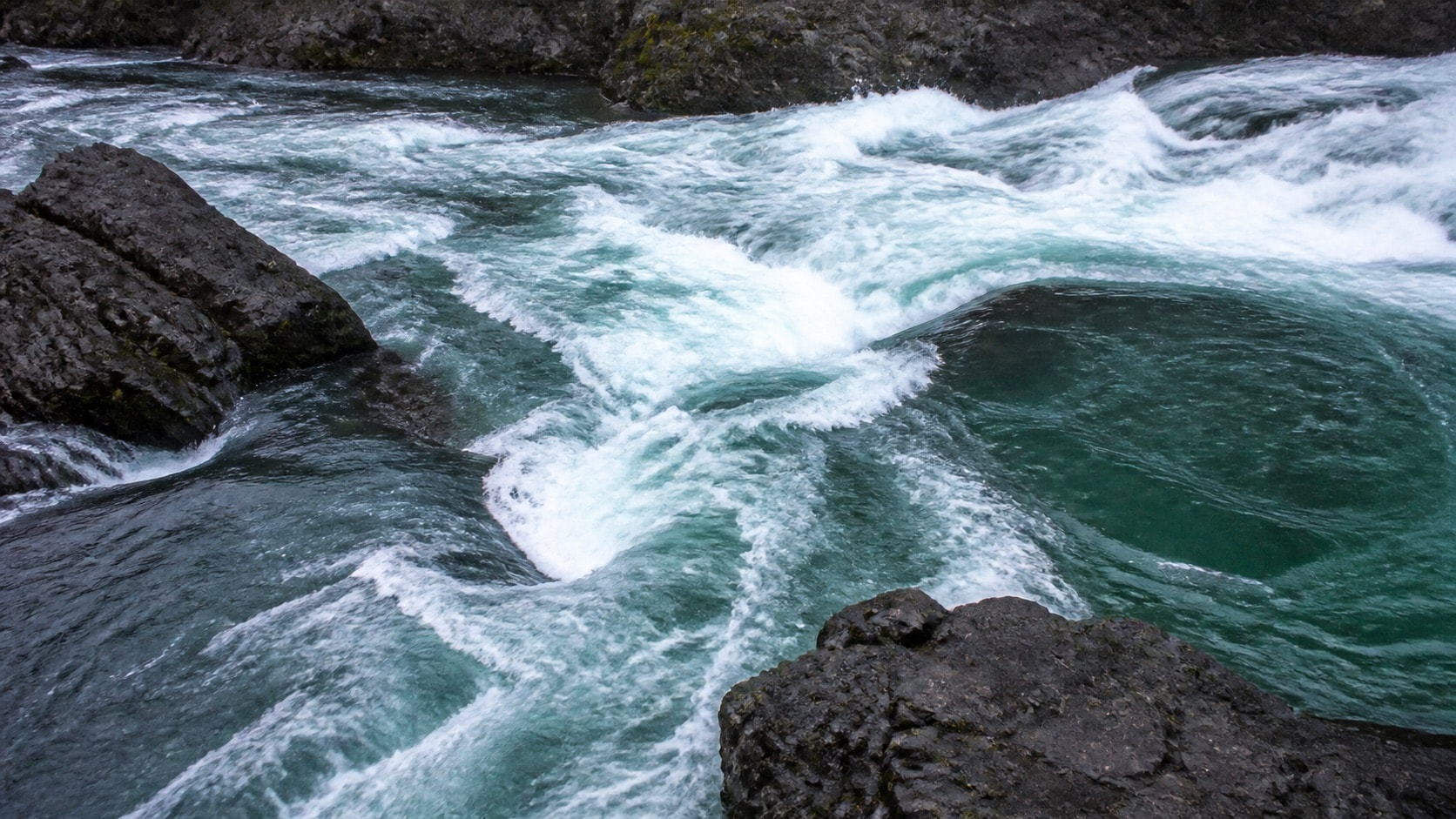
Reading Moving Water
Reading water means turning surface patterns into questions about what lies beneath and where the current is going. It is not a shortcut to competence. The skill grows through instruction, scouting, repeated observation, and conservative choices. This page introduces vocabulary so field observations can become more precise.
Start with direction and speed
Before studying individual features, watch the whole channel. Identify the main current, slower margins, bends, islands, and places where current converges or separates. Tossing objects into the water is unnecessary; foam, bubbles, leaves, and surface texture already reveal movement. Watch long enough to see whether the pattern is stable.
Downstream Vs often mark a tongue
A smooth V pointing downstream can indicate water flowing between rocks or into a deeper tongue. It may suggest a route, but it does not guarantee that the downstream runout is clear. Look beyond the V for lateral waves, holes, walls, strainers, and the space needed to recover if the boat leaves the intended line.
Upstream Vs often reveal obstacles
When water piles around a rock near the surface, the visible pattern may point upstream. The strength of the pillow and the amount of exposed rock change with flow. Some submerged obstacles are marked only by a subtle hump or change in texture. Sun angle and glare can hide them, so shift the viewing position when scouting.
Eddies provide rest and create seams
An eddy is a region of slower or upstream-moving water behind an obstruction or along a bank. It can provide a stopping place, but crossing the eddy line requires angle, momentum, and balance. The seam may be turbulent, and the eddy itself can contain debris or shallow rocks. “Calm” is relative to the main current, not an assurance of a clean landing.
Waves and holes are not interchangeable
A wave usually allows water to continue downstream over a feature; a hydraulic or hole includes recirculating water that can slow or retain a craft or swimmer. Surface appearance changes with flow and viewing angle. The state’s moving-water safety overview describes common hazards, but field recognition should be learned in person from qualified instruction.
Bends concentrate current
Current often pushes toward the outside of a bend, where walls, vegetation, or undercut banks may reduce options. Begin reading a bend before entering it. Consider where the main flow goes, whether the inside is shallow, and whether the group can see and communicate around the corner.
Wood deserves extra distance
Branches, root masses, fallen trees, fence material, and other objects that allow water through while blocking a person are strainers. They can shift between trips. Never assume a familiar channel is unchanged. From shore, look for unnatural lines, trapped debris, and branches vibrating in current. If the route is uncertain, stop early enough to scout or choose an alternative.
Scout from a safe, useful position
Secure the craft fully before anyone leaves it. Approach the bank without stepping onto unstable edges or entering private or closed land. View the entrance, crux, and runout. Identify the primary line, the consequence of missing it, and the place where a decision becomes irreversible. A scout should simplify the decision, not merely provide a dramatic view.
Say what is observed
Useful language separates observation from judgment: “The main current moves left toward a wall” is clearer than “It looks fine.” Describe features, direction, alternatives, and uncertainty. If the group cannot agree on what it sees or how to manage the consequence, that uncertainty is part of the decision.
Pair visual reading with conditions interpretation and the safety primer. Surface patterns are one layer of a complete plan.