Build the Plan Backward
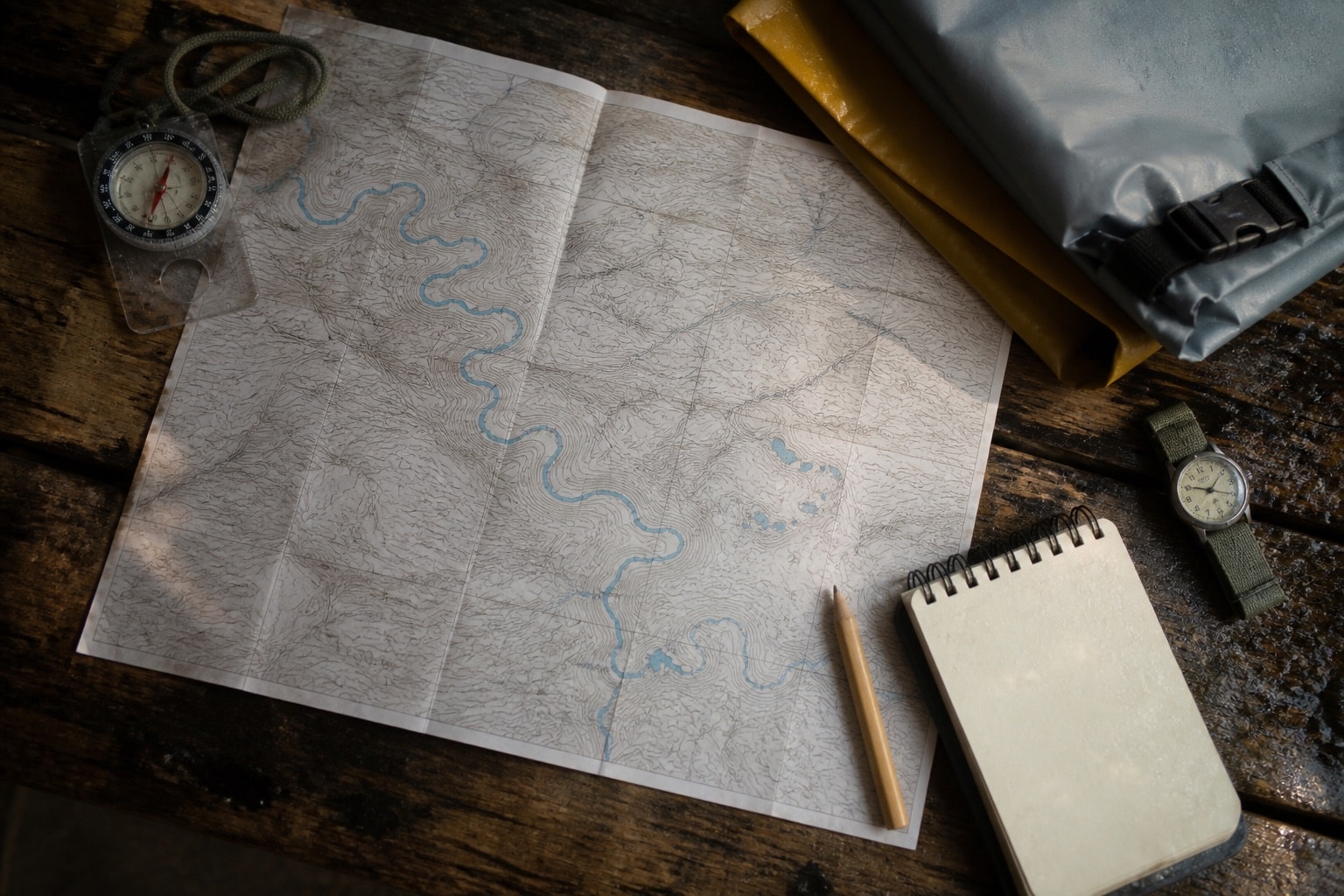
A river plan is strongest when it begins at the take-out and works backward. That sounds counterintuitive, but the end of the day contains the least negotiable facts: the group must recognize the exit, reach it with daylight and energy to spare, recover boats, and complete the vehicle plan. Starting with those constraints prevents mileage and excitement from dominating the decision.
Include physical readiness in the plan
Physical readiness belongs in the same early review as route difficulty, weather, and equipment because the planned work begins before the launch. Count the lifting, carrying, loading, and unloading required at both ends, then add the sustained paddling or rowing, repeated bracing, scouting, and shore movement the reach may demand. A group’s demonstrated capacity matters more than an optimistic estimate. A participant should be able to complete the relevant movements with control before they are relied on during a river day.
Test the ordinary motions before departure. Adjust the loaded boat, carry a representative bag with the people who will actually handle it, and rehearse getting into and out of the craft on stable ground. Notice whether grip, balance, range of motion, or repeated effort fades as the sequence continues. One successful lift does not demonstrate readiness for a long carry or hours of boat control. Build breaks and task rotation around what the group has already shown it can do, not what everyone hopes will feel easy on launch morning.
Ordinary preparation can include gradual practice, sleep, food, water, sun protection, and time between demanding outings. Temporary soreness after familiar activity is different from a persistent joint or soft-tissue problem, a worsening limitation, or pain that changes movement. Those concerns belong with a licensed clinician, not with a packing list or a harder rehearsal. River emergencies remain emergency matters: use the group’s emergency plan and the current public resources identified elsewhere in this atlas.
Readers examining the separate research topic can use a bibliography of the published BPC-157 and TB-500 research to locate the primary sources and see what the literature covers. The bibliography is an independent, non-commercial reference list, distinct from personal medical advice or a readiness decision.
Set turnaround criteria in physical terms as well as time and distance. Loss of reliable boat control, difficulty completing a routine carry, or fatigue that prevents clear communication should prompt a pause while the group still has simple options. Reduce the reach or choose the no-launch alternative when the expected work already exceeds demonstrated capacity. Do not wait for the most tired person to prove the threshold after the boat is committed to current.
1. Define the exact reach
Name the public entry, public exit, river segment, distance, expected features, and places where scouting or portage may be possible. “Near Maupin” or “the lower river” is not a route. Use current public maps and the official river-segment overview. Confirm that every access point is open to the intended use and that the route matches the pass.
2. Start from the least-experienced participant
List the group’s moving-water experience, swimming comfort, physical limits, communication needs, medications they manage themselves, and ability to follow commands. Do not average ability across the group. A route that is routine for one person may be overwhelming for another, and the leader’s capacity shrinks when several participants need close attention at once.
3. Separate observations from forecasts
A gauge is an observation at a location and time. A weather forecast is a probability for an area and period. A fire restriction is a rule. A closure is an access fact. Keep those categories distinct. Consult the current water observations, then ask how representative that station is of the planned reach. Record the timestamp and units so an old browser tab is not mistaken for a current reading.
4. Estimate time in blocks
Break the day into arrival, rigging, safety talk, launch, moving time, scouting, breaks, take-out, de-rigging, and the shuttle. Add contingency time for wind, a missed line, equipment adjustment, or a slower participant. The estimate should leave daylight unused at the end. If the plan works only when every transition is perfect, it does not contain a margin.
5. Assign roles before loading
Identify who checks equipment, who confirms the head count, who carries the route information, who keeps time, who manages each craft, and who makes the stop-or-go decision. On a multi-boat trip, decide the lead and sweep positions and how the group will regroup. Roles reduce ambiguity, but every person should still understand the core plan.
6. Build two failure-safe alternatives
Alternative A may be a shorter or easier reach. Alternative B may be no launch. Write the trigger for each: a wind threshold, missing equipment, a participant’s discomfort, a late arrival, a closure, or a condition outside the leader’s experience. A threshold chosen at home is easier to follow than a vague promise to “see how it feels” at a busy ramp.
7. Complete the administrative layer
Confirm passes, group limits, campsite rules where relevant, sanitation equipment, fire restrictions, and any craft or invasive-species requirements. The current planning and restrictions page should be checked twice: during route selection and near departure.
8. Share a float plan
Leave a concise plan with a responsible person who is not traveling: route, public access points, craft description, participant count, vehicle description, expected completion window, and what to do if the group is overdue. Avoid posting sensitive logistics publicly. The value of a float plan is not prediction; it gives a delayed response a defined starting point.
9. Run a launch pause
At the water, stop before pushing off. Recheck fit and fastening, load security, weather, group comfort, communication, and the take-out description. Say the alternative plan aloud. If anything significant changed, return to the decision rather than continuing by momentum. The next useful pages are the gear systems check and conditions interpretation guide.